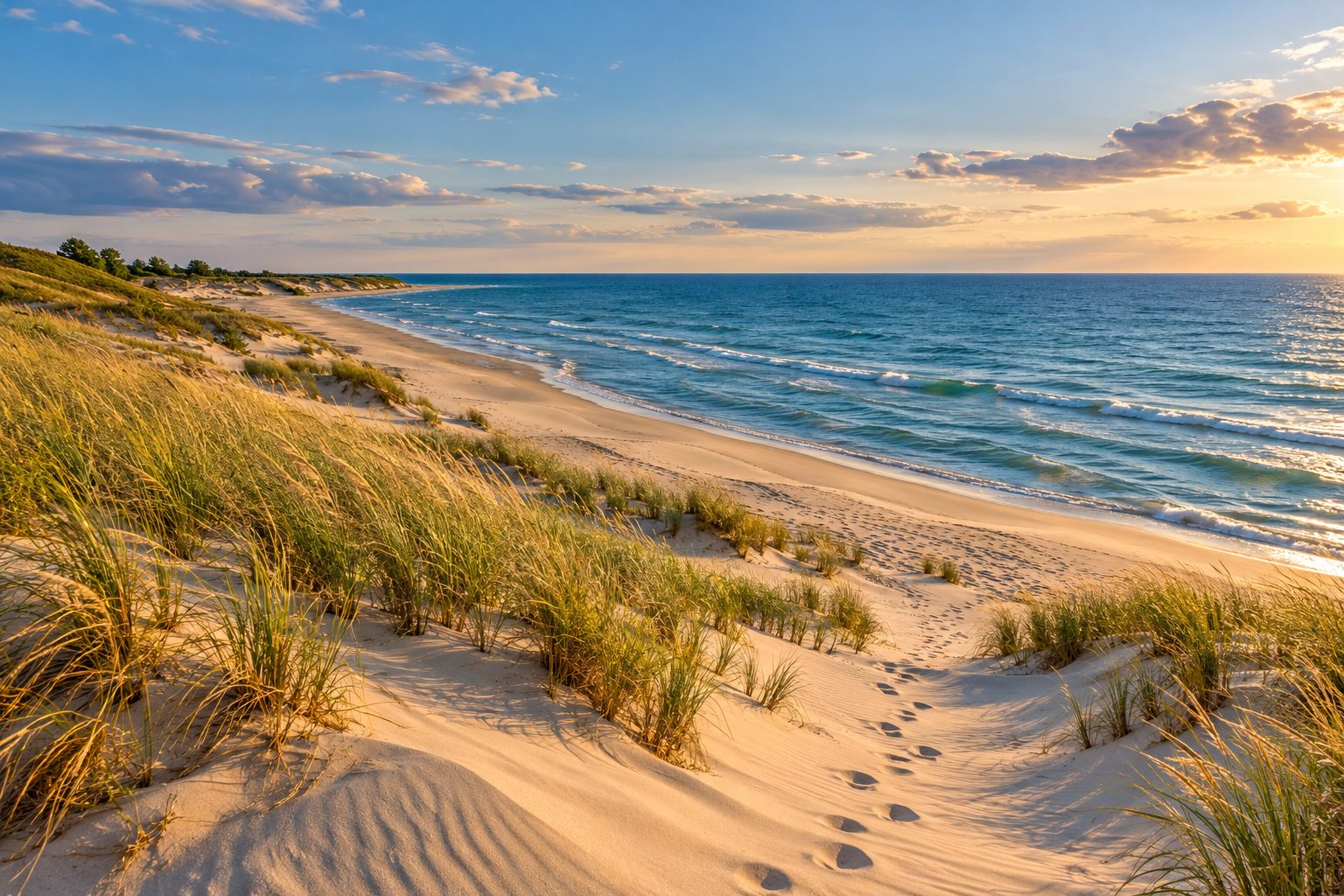
Sleeping Bear Dunes is the most photographed stretch of Lake Michigan's eastern shore, and the two things most visitors want to do are also the two that require the most planning: the Pierce Stocking Scenic Drive and the Dune Climb.
What the park actually is
Despite the scale, Sleeping Bear Dunes is a national lakeshore rather than a national park, which affects how it is run. Entry requires a pass, the popular areas have their own parking, and the land is a mix of dunes, forest, inland lakes and the two Manitou islands offshore. It is long and narrow: the scenic drive is near Empire, the Dune Climb further north near Glen Arbor, and both sit inside the same shoreline.
The two headline stops
Pierce Stocking Scenic Drive is a short loop with numbered overlooks, including the Lake Michigan overlook where people run down the dune face to the water. That descent is a serious climb back up in soft sand, takes far longer than it looks, and routinely draws rescue calls. Watch it from the platform instead.
The Dune Climb is the accessible option: a steep sand slope that children treat as a slide and adults treat as a workout. It needs no reservation, only patience for the car park.
Beyond the dunes
- Glen Arbor and Empire are the two small towns that serve the park, with food, rentals and outfitters.
- The inland lakes suit paddling when the lake wind picks up.
- South Manitou Island rewards a full day and a ferry booking, and most visitors skip it.
Go early or go in September. The dune car parks are the single biggest constraint on a summer visit.
Practical notes
- A park pass is required for entry; buy it before you arrive.
- Sand gets into everything. Closed shoes beat sandals on the climbs.
- Weather on Lake Michigan changes fast. A calm morning can turn into a windy, cold afternoon.